How to Separate Trash in South Korea
We provide a detailed guide on South Korea's complex trash separation and disposal methods, covering differences between apartments, houses, and regions. With this, you'll be a waste management expert!
Waste Sorting in Korea: Become a Pro with This Guide! (Complete Breakdown of Differences by Apartment, House, and Region)
The first gateway to life in Korea is trash separation!
Were you often confused because the disposal methods differ for apartments, villas, and each district (Gu/Gun)?
This article solves all your concerns. For those in a hurry, check the key summary table and the pre-disposal checklist first.
💡 Korea Waste Sorting Quick Summary
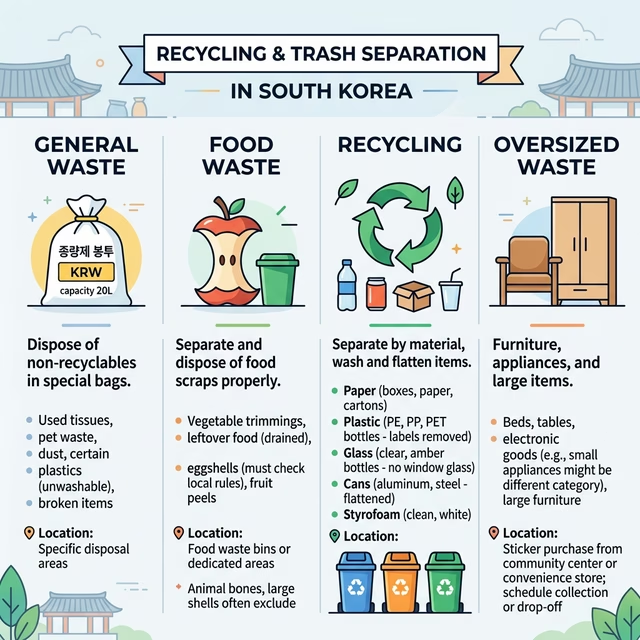
Category | Disposal Spot (Apartments) | Disposal Spot (Villas/Houses) | Dedicated Bag Required |
|---|---|---|---|
General Trash | Always available in complex | Designated day/time in front of house | ✅ Local Standardized Trash Bag required |
Food Waste | Dedicated container (e.g., RFID) | Designated day/time in front of house | ✅ Dedicated bag or sticker |
Recyclables | Separate in item-specific bins | Put in transparent bag at once | ❌ Usually free (plastic bag needed) |
Bulky Waste | Designated spot by management | Pre-report to district office/community center | ✅ Buy & attach waste disposal sticker |
✅ Essential Checklist Before Throwing Away! (3-Step Checklist)
Have you completely emptied the contents?
Have you rinsed it with water so there is no residue?
Have you completely separated materials like labels and lids? (If you don't follow these 3 steps, it cannot be recycled! Please throw it all away in a 'General Trash' standardized bag.)
1. The Basics of Separation: Remember These 4 Categories!
These are the universal principles applied regardless of the region.
General Trash: All trash that cannot be recycled.
Food Waste: Food that animals can eat.
Recyclables: Items that can be used as resources again.
Bulky Waste: Large items like furniture and appliances that cannot fit in standard bags.
The Most Important Principle! Empty it, rinse it, separate it, and don't mix it! Recyclable items must have their contents emptied, rinsed with water to remove residue, and then disposed of. Please throw contaminated recyclables in the general trash.
2. Differences by Residence Type: Apartments vs. Villas/Detached Houses
The biggest difference is 'when and where' you throw it away.
🏢 Apartments
Apartments have a well-equipped waste sorting system within the complex, which is relatively convenient.
Disposal Location: There is a designated 'Recycling Area' within the complex, usually open at all times.
Disposal Days:
Recyclables: Usually collected on designated days once or twice a week (e.g., "Every Wednesday", "Every Tuesday and Friday"). You must check the exact schedule via the apartment management office or announcements.
General/Food Waste: Available for disposal every day in most cases.
Trash Bags:
General Trash: Use the Standardized Garbage Bag (Jongnyangje) of the District (Gu) you live in.
Food Waste:
RFID Card Method: The most common method where you tag your household card and pay based on the weight of the waste. (No separate bag needed)
Dedicated Food Waste Bags: Purchased at convenience stores or supermarkets.
Recyclables: No separate bag required; place directly into the item-specific bins (plastic, cans, paper, etc.) at the recycling area.
🏡 Villas and Detached Houses
Living in a villa or a detached house requires a bit more attention. You must strictly follow the local government's rules.
Disposal Location: Put it out in front of your door or at a designated collection point in the neighborhood.
Disposal Days and Times:
This is the most important part! The disposal days and times are set by region (Gu/Dong).
Usually, a 'Day-of-the-Week System' is implemented, meaning only specific items can be disposed of on specific days. (e.g., Mon/Wed/Fri - General/Food, Tue - Plastic/Vinyl, Thu - Paper/Cans)
Disposal time is usually set from 'after sunset until the next morning'. If you dispose outside of the designated time, it might not be collected or you could be fined.
Trash Bags:
General/Food Waste: Use the Standardized Garbage Bag (Jongnyangje) of the District (Gu) you live in.
Recyclables: In many cases, you must put all recyclables into one 'transparent or semi-transparent' plastic bag. Some regions require different bags for different items, so be sure to check.
⭐ Where can I find my neighborhood's disposal information? The most accurate way is to check the website of your local District Office or inquire at your local Community Center (Administrative Welfare Center). Try searching for '[District Name] trash disposal day'.
3. Detailed Guide for Confusing Items
Category | Examples | Disposal Method | Notes |
|---|---|---|---|
General Trash | Soiled tissue/vinyl, bones, shellfish shells, eggshells, fruit seeds, broken glass/ceramics, toothbrushes | Put in a local standardized bag | Wrap broken glass in newspaper and mark 'DANGER'! |
Food Waste | Fruit peels (soft ones like banana/apple), vegetables, leftovers | Drain moisture as much as possible | Confusing items: Hard shells (nuts, clams), bones, seeds, tea bags, herbal medicine residue go in General Trash |
Paper | Newspapers, books, boxes, paper bags | Keep dry, remove tape/springs/plastic coating, and stack | Receipts, photos, and coated flyers go in General Trash |
Cans/Metals | Beverage/canned food cans, butane gas, wire | Empty contents and rinse. Separate plastic lids | Butane gas/spray: Must punch a hole to release gas completely before disposal |
Glass | Beverage bottles, liquor bottles, cosmetic bottles | Empty and rinse. Separate lids by material | Soju/beer bottles can be returned to marts for deposit refunds! |
Plastic | PET bottles, plastic containers, yogurt bottles | Empty, rinse, remove attached vinyl labels, and crush | Medicine packaging, toothbrushes, cassette tapes go in General Trash |
Vinyl | Snack/ramen bags, disposable plastic bags | Rinse clean and place in a transparent/semi-transparent bag | If residue cannot be removed, put in General Trash |
Styrofoam | Appliance cushions, cup noodle containers, fruit boxes | Empty, rinse clean, and remove all tape/labels | Contaminated or colored Styrofoam goes in General Trash |
4. How Do I Dispose of These? Special Waste Disposal
Bulky Waste (Furniture, Appliances, etc.)
Report online via the District Office website or visit/call the Community Center.
Pay the fee and print/attach the disposal permit (sticker).
Leave it at the designated spot for pickup.
Clothing and Shoes
Put them in the 'Clothing Collection Bin' in the neighborhood.
Note: Do not put cotton blankets, pillows, cushions, or dolls in these bins. They must be reported as bulky waste or put in a general trash bag.
Batteries, Fluorescent Lights, Expired Medicine
Batteries/Fluorescent Lights: Dispose of them in the dedicated collection bins found in apartment recycling areas or community centers.
Expired Medicine: Never throw them in the trash or down the drain. Take them to a nearby pharmacy.
Closing
Sorting trash in Korea may seem to have many rules at first, but you'll get used to it after a few times. By accurately checking the rules for your neighborhood and following the habit of rinsing items clean, you are making a huge contribution to protecting the environment and keeping our community clean.